Inside the ISAT Chamber: How BioGene Is Engineering Climatic Endurance for EVs and Batteries

A technical look at defence-grade climatic qualification applied to modern EV and battery validation

Electric vehicle battery packs don't fail in the lab. They fail on a highway in Rajasthan at 48°C, or in a Himalayan supply depot at -20°C after three years of humidity cycling nobody accounted for. That gap — between clean lab data and real-world climatic abuse — is exactly what BioGene's ISAT (Intensified Standard Alternating Trial) Chamber is built to close.

Manufactured by Biotechnologies Inc., a DRDO SAMAR Level-3 certified environmental simulation company with over three decades of engineering experience, the ISAT chamber sits at the intersection of two worlds that rarely get discussed together: defence-grade climatic qualification and modern EV/battery validation. Here's a technical look at what the chamber does, how it's built, and which standards actually govern it.

What Is an ISAT Chamber, Technically?

ISAT stands for Intensified Standard Alternating Trial — a climatic test protocol originally developed for qualifying explosive-filled defence components, where failure isn't an inconvenience, it's catastrophic. The chamber cycles a test article through alternating extremes of temperature, humidity, and ambient condition — including forced condensation — combined with a periodic dry-heat phase that replicates tropical, desert-like exposure.

BioGene's production ISAT chamber has a working capacity of 7,200 litres, large enough to accommodate full sub-assemblies rather than isolated cells or coupons, and supports two recognized trial variants:

  • ISAT (A) — cyclic temperature/humidity/condensation exposure with an embedded dry-heat interval
  • ISAT (B) — a modified stress profile for a slightly different environmental exposure sequence

Running both variants lets engineers separate two failure modes that often get conflated in simpler test regimes: moisture ingress/corrosion failures versus pure thermal-cycling fatigue.

Why This Matters for EV and Battery Programs

Munitions engineers adopted ISAT because they needed proof that a component's performance and shelf life wouldn't degrade after years of uncontrolled climatic exposure. Battery packs face an almost identical reliability question — a cell or module that passes a single-cycle thermal shock test can still fail after eighteen months of real-world humidity-condensation-heat cycling in the field. ISAT's alternating-trial methodology gives EV and energy-storage manufacturers a way to compress years of field exposure into weeks of chamber time, surfacing:

  • Seal and gasket degradation from repeated condensation cycles
  • Corrosion at busbar and connector interfaces
  • Insulation resistance drift under humidity-heat alternation
  • Long-term capacity fade correlated with climatic stress, not just charge cycling

Build Quality: What's Actually Inside the Chamber

A chamber that runs weeks-long alternating cycles has to survive its own test regime without becoming the failure point. BioGene's construction reflects that:

  • Monoblock construction with the outer shell phosphate-primed and finished in RAL 7035 epoxy electrostatic powder coating for a wear-resistant, corrosion-resistant exterior
  • Interior: pre-polished, high-gloss AISI-304 stainless steel, 1.2 mm thick, with a reinforced floor to carry heavy battery packs or defence sub-assemblies without deformation
  • Insulation: ~150 mm of PUF (polyurethane foam) between the inner cell wall and outer housing, holding internal setpoints stable against ambient drift
  • Observation window, internally illuminated, so operators can visually monitor the test article mid-cycle without breaking the controlled environment
  • Digital PID controller with LCD display for programmable temperature/humidity profiling

For dedicated EV/battery-focused chamber configurations, BioGene also builds in explosion-proof construction options, non-sparking fan blades, reinforced floors rated for pack-level loads, and LN2 surface-cooling provisions to help arrest thermal excursions during abuse testing — features that matter once you're cycling live lithium-ion packs rather than passive components.

The Standards Question: MIL-STD, CE, and Where They Actually Apply

It's worth being precise here, because "MIL CE standards" gets used loosely in the industry and the two frameworks serve very different purposes:

MIL-STD-810 (G/H revisions) is a US military test-method standard defining how to environmentally stress-test equipment — thermal shock, humidity, altitude, vibration, sand and dust, and so on. It's a testing methodology standard, not a product certification.

CE marking is a regulatory conformity mark required for equipment sold in the European Economic Area, covering directives like the Low Voltage Directive and EMC Directive. It certifies the chamber itself is safe and compliant to sell and operate — it doesn't certify battery performance.

BioGene's chambers are built to MIL-STD-810G/H test methodology and carry CE, ISO, JIS, and BIS compliance, with the manufacturing facility holding DRDO SAMAR Level-3 certification for defence manufacturing excellence.

For the batteries and packs actually being tested inside these chambers, the relevant standards are a different, battery-specific set:

StandardScope
UN 38.3Transport safety testing for lithium batteries
IEC 62133 / IEC 62619Safety requirements for portable and industrial lithium cells/batteries
SAE J2464Abuse testing for EV and hybrid propulsion battery systems
UL 2580Batteries for use in electric vehicles
GB/T 31485 / GB/T 31467Chinese national standards for EV traction battery safety and cycle life
IS 16046Indian standard for secondary lithium cells and batteries
ISO 12405Test specifications for lithium-ion traction battery packs and systems

A chamber built to MIL-STD-810/CE gives you a qualified, safe, repeatable environment. The battery standards above define what you actually do inside it. Conflating the two is a common but important mistake when specifying a test program.

Where This Fits in a Test Program

In practice, an ISAT chamber complements rather than replaces dedicated battery-abuse chambers. A typical validation sequence looks like:

  1. Cell/module-level abuse testing (overcharge, short-circuit, thermal runaway propagation) in an explosion-proof battery test chamber
  2. Pack-level thermal shock and cycling per SAE J2464 / ISO 12405
  3. Long-duration climatic endurance in the ISAT chamber — alternating humidity, condensation, and dry-heat cycling to simulate multi-year field exposure on seals, connectors, and structural integrity
  4. Altitude and transport simulation per UN 38.3, where applicable

The ISAT chamber's role is specifically that third stage: proving durability against the slow, cumulative climatic stress that shorter single-parameter tests can't reveal.

The Bottom Line

BioGene's ISAT chamber brings a defence-grade, decades-proven climatic stress methodology to a problem the EV and energy-storage industry is still catching up on — proving that a battery pack survives not just one bad day, but years of alternating heat, humidity, and condensation. Built on MIL-STD-810G/H test methodology, CE-compliant construction, and backed by DRDO SAMAR Level-3 manufacturing certification, it's a chamber designed for the kind of reliability question that only surfaces after the warranty period starts.

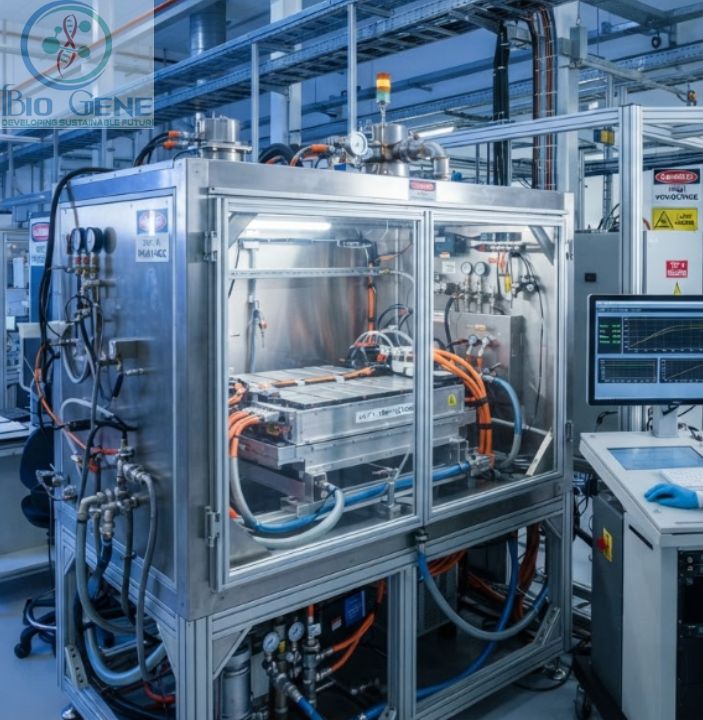
EV Battery Testing Chamber Applications

  • Climatic endurance and reliability testing of EV battery packs, modules, and cells under alternating heat, humidity, and condensation cycles
  • Validation of battery management systems (BMS), busbars, connectors, and seals against long-term environmental exposure
  • Simulating multi-year field conditions — tropical humidity, desert heat, condensation ingress — in compressed chamber time
  • Pre- and post-abuse conditioning for cell/pack-level thermal runaway and short-circuit testing programs
  • Qualification testing for automotive OEMs, battery manufacturers, energy-storage system (ESS) developers, and defence sub-assembly programs
  • Corrosion and insulation-resistance evaluation at busbar and connector interfaces
  • Capacity-fade correlation studies tied to climatic stress rather than charge-cycle stress alone

EV Battery Testing Chamber Features

  • ISAT (Intensified Standard Alternating Trial) test protocol with ISAT (A) and ISAT (B) trial variants for separating moisture/corrosion failure from thermal-cycling fatigue
  • 7,200-litre working capacity, sized to accommodate full battery sub-assemblies rather than isolated coupons
  • Internally illuminated observation window for real-time visual monitoring without breaking the controlled environment
  • Explosion-proof construction option with non-sparking fan blades for live lithium-ion pack testing
  • LN2 surface-cooling provision to help arrest thermal excursions during abuse testing
  • Reinforced, pack-rated floor loading for heavy battery assemblies
  • Uniform temperature and humidity distribution across the working chamber
  • Low-noise, energy-efficient refrigeration and humidity-generation system

Control

  • Digital PID controller with LCD display for closed-loop temperature and humidity regulation
  • Programmable multi-step/multi-ramp profiling to run ISAT (A) and ISAT (B) cycles automatically
  • Real-time set-point vs. actual-value display with alarm indication for over-temperature, over-humidity, sensor fault, and door-open conditions
  • Data logging of temperature/humidity profiles for traceability and test-report generation
  • Safety interlocks: door safety switch, high-limit thermal cutout, low-water/level protection for the humidity system
  • Optional PC/SCADA connectivity for remote monitoring and multi-chamber profile management

Construction

  • Outer shell: Monoblock construction, phosphate-primed and finished in RAL 7035 epoxy electrostatic powder coating for corrosion and wear resistance
  • Interior chamber: Pre-polished, high-gloss AISI-304 stainless steel, 1.2 mm thickness, with a reinforced floor rated for heavy battery-pack loads
  • Insulation: ~150 mm of polyurethane foam (PUF) between the inner cell wall and outer housing for stable internal set-points against ambient drift
  • Door: Heavy-duty, gasket-sealed door with viewing window and internal illumination
  • Fan system: Non-sparking, explosion-proof fan blades for safe forced-air circulation during live battery testing
  • Cooling: Mechanical refrigeration system with optional LN2 surface-cooling assist for rapid thermal excursion control
  • Cable/port access: Sealed cable pass-through ports for battery instrumentation, BMS leads, and data acquisition wiring

EV Battery Testing Chamber Specification

Working Capacity7,200 Litres
Test ProtocolISAT (A) and ISAT (B) — Intensified Standard Alternating Trial
Interior MaterialAISI-304 stainless steel, 1.2 mm, high-gloss pre-polished finish
Exterior FinishRAL 7035 epoxy electrostatic powder coating over phosphate primer
Insulation~150 mm polyurethane foam (PUF)
ControllerDigital PID controller with LCD display, programmable profiling
Safety FeaturesExplosion-proof construction option, non-sparking fan blades, door safety interlock, high-limit thermal cutout
Cooling AssistLN2 surface-cooling provision for thermal excursion arrest
Floor LoadingReinforced floor rated for battery pack / defence sub-assembly loads
ComplianceMIL-STD-810G/H test methodology; CE, ISO, JIS, BIS compliant construction
Manufacturing CertificationDRDO SAMAR Level-3 certified facility

It's used to climatically stress-test EV battery packs, modules, and cells — cycling them through alternating temperature, humidity, and condensation extremes (the ISAT protocol) to reveal long-term reliability issues like seal degradation, connector corrosion, insulation-resistance drift, and capacity fade before they show up in the field.

ISAT stands for Intensified Standard Alternating Trial. Unlike a single-parameter thermal or humidity chamber, ISAT alternates temperature, humidity, forced condensation, and a dry-heat interval in a repeating cycle — compressing years of real-world climatic exposure into weeks of test time. It runs two variants, ISAT (A) and ISAT (B), so engineers can separate moisture/corrosion failure modes from pure thermal-cycling fatigue.

Yes. For EV/battery-focused configurations, the chamber can be built with explosion-proof construction, non-sparking fan blades, a reinforced pack-rated floor, and an LN2 surface-cooling provision to help arrest thermal excursions during abuse-adjacent testing scenarios.

The chamber has a 7,200-litre working capacity — large enough for full battery sub-assemblies and pack-level hardware, not just individual cells or small coupons.

The chamber itself is built to MIL-STD-810G/H test methodology and carries CE, ISO, JIS, and BIS compliance. The manufacturing facility holds DRDO SAMAR Level-3 certification. It's important to note this certifies the chamber as a qualified test environment — it does not certify the battery being tested inside it.

Common battery-specific standards run alongside ISAT climatic testing include: UN 38.3 – transport safety testing for lithium batteries IEC 62133 / IEC 62619 – safety of portable and industrial lithium cells/batteries SAE J2464 – abuse testing for EV/hybrid propulsion battery systems UL 2580 – batteries for use in electric vehicles ISO 12405 – test specifications for lithium-ion traction battery packs IS 16046 – Indian standard for secondary lithium cells and batteries

The interior is pre-polished, high-gloss AISI-304 stainless steel (1.2 mm thick) with a reinforced floor. The exterior is monoblock construction, phosphate-primed and finished in RAL 7035 epoxy electrostatic powder coating. Insulation is roughly 150 mm of polyurethane foam (PUF) between the inner and outer walls.

A digital PID controller with an LCD display manages programmable temperature/humidity profiling, so ISAT (A) and ISAT (B) cycles can run automatically without manual intervention between phases.

Typically as the third stage of a four-stage sequence: (1) cell/module-level abuse testing in an explosion-proof battery chamber, (2) pack-level thermal shock and cycling per SAE J2464 / ISO 12405, (3) long-duration climatic endurance in the ISAT chamber, and (4) altitude/transport simulation per UN 38.3 where applicable.

These vary by configuration and test requirement. Contact Biotechnologies Inc. directly at +91-9811701133 for a detailed datasheet and quote matched to your specific EV battery testing program.
×